
Description
A Masterpiece of Imperial History & Horological Artistry
Presenting an exceptionally rare, museum-quality antique silver pocket watch, explicitly crafted for the elite Chinese market during the late Qing Dynasty. This breathtaking timepiece honors the legacy of Empress Dowager Cixi, one of the most powerful and influential figures in Chinese history.
Watches of this caliber were historically commissioned from elite Swiss watchmakers (such as those in Fleurier) as royal presentation pieces or diplomatic gifts intended for the Imperial Court. Combining a vivid portrait dial, an incredibly rare integrated compass, and a profoundly engraved skeletonized movement, this watch is a true investment-grade artifact.
HISTORICAL CONTEXT: THE CHINESE MARKET & EMPRESS CIXI During the 19th and early 20th centuries, European master watchmakers fiercely competed to create the most lavish, technologically fascinating timepieces for the Chinese Imperial Court and high nobility. Empress Dowager Cixi (1835–1908), the de facto ruler of the Qing Dynasty for nearly five decades, was known for her immense wealth and appreciation for intricate, automated, and jewel-encrusted Western mechanical treasures. A watch bearing her likeness would have been a piece of immense prestige, celebrating her authority and status.
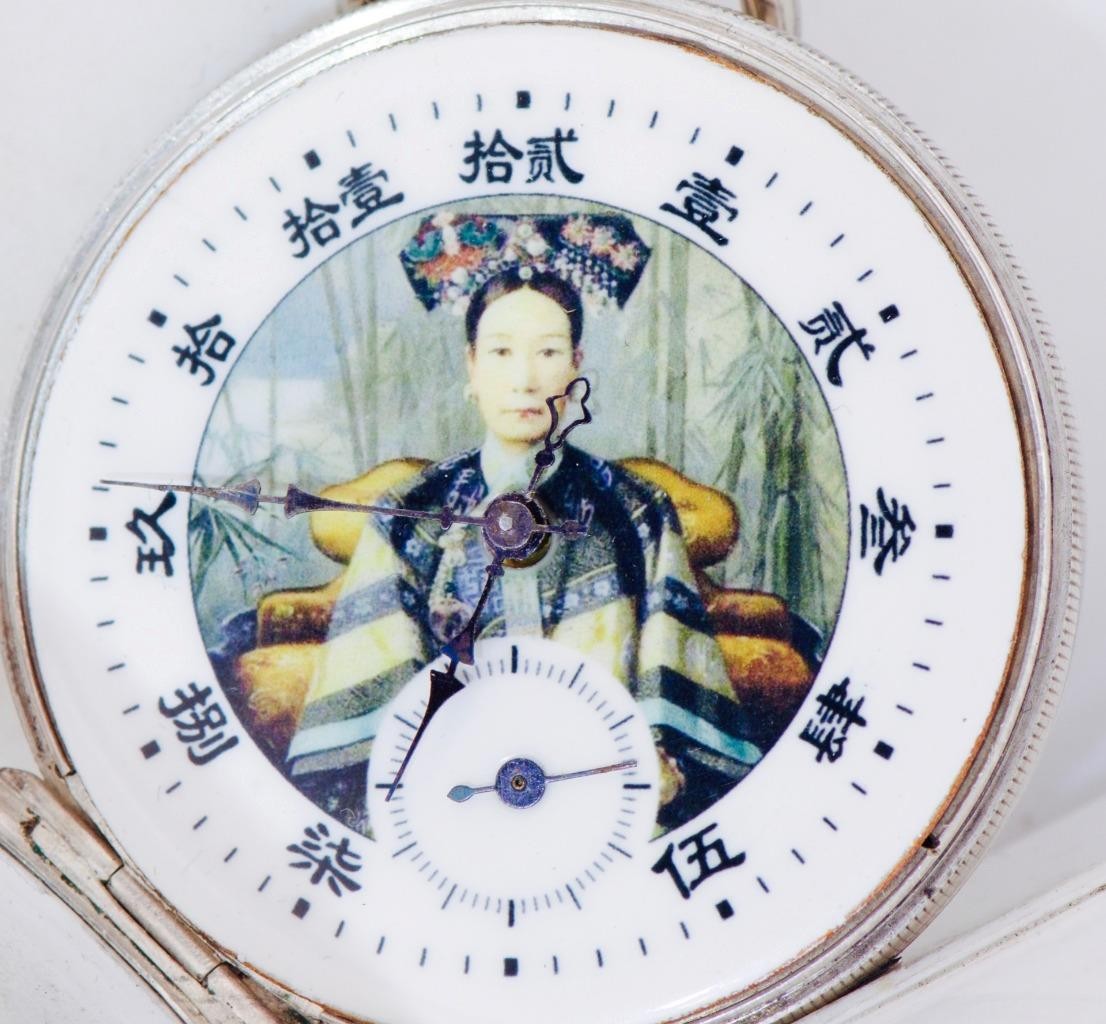
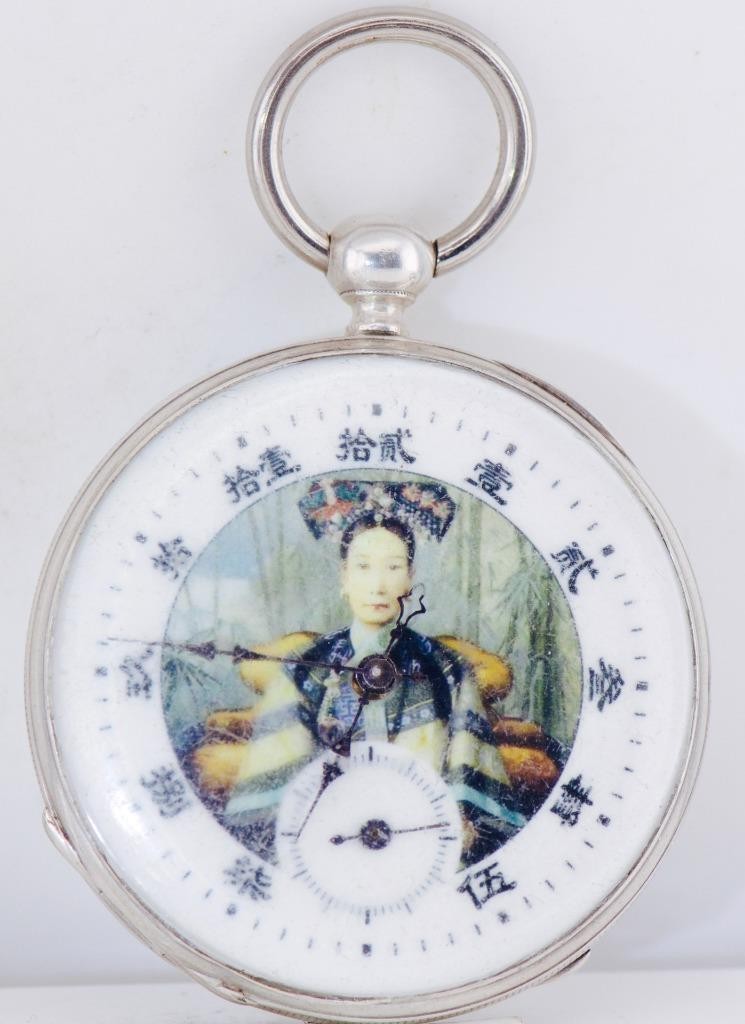
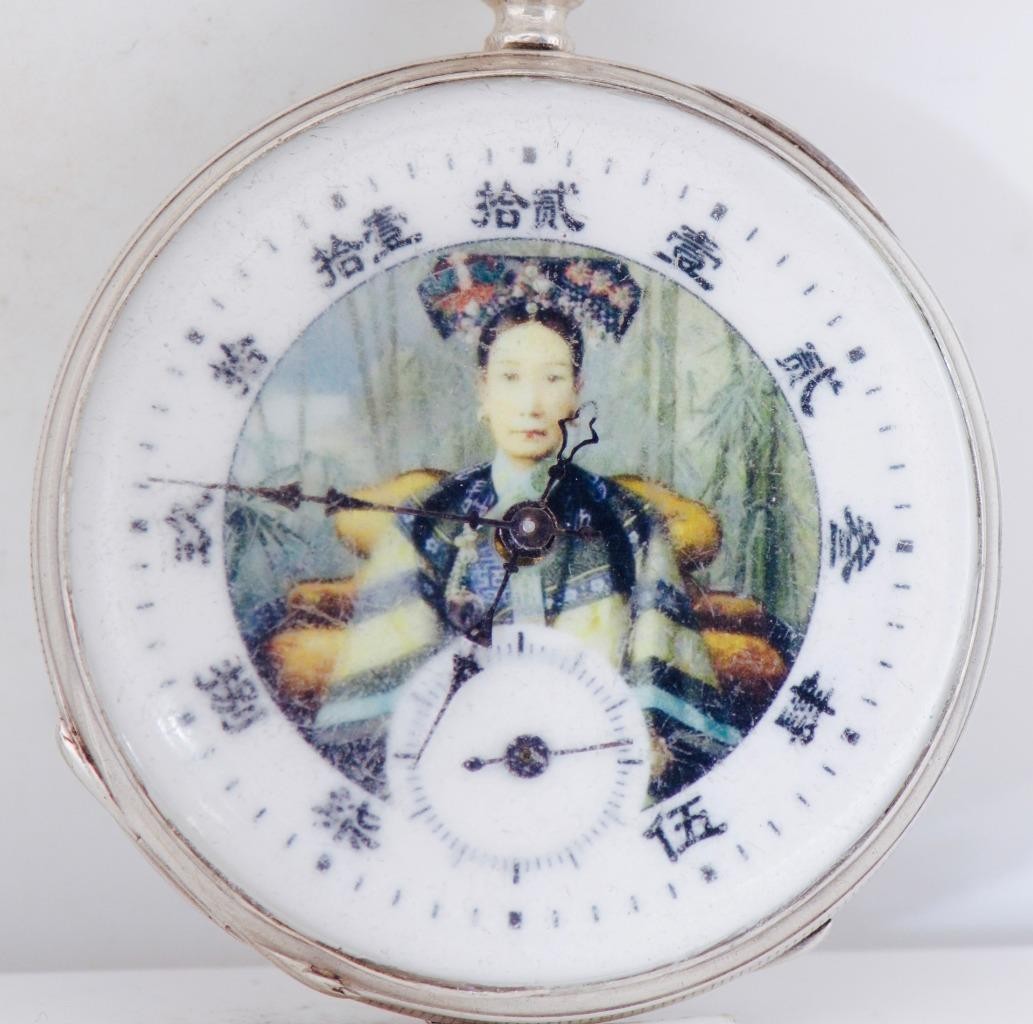
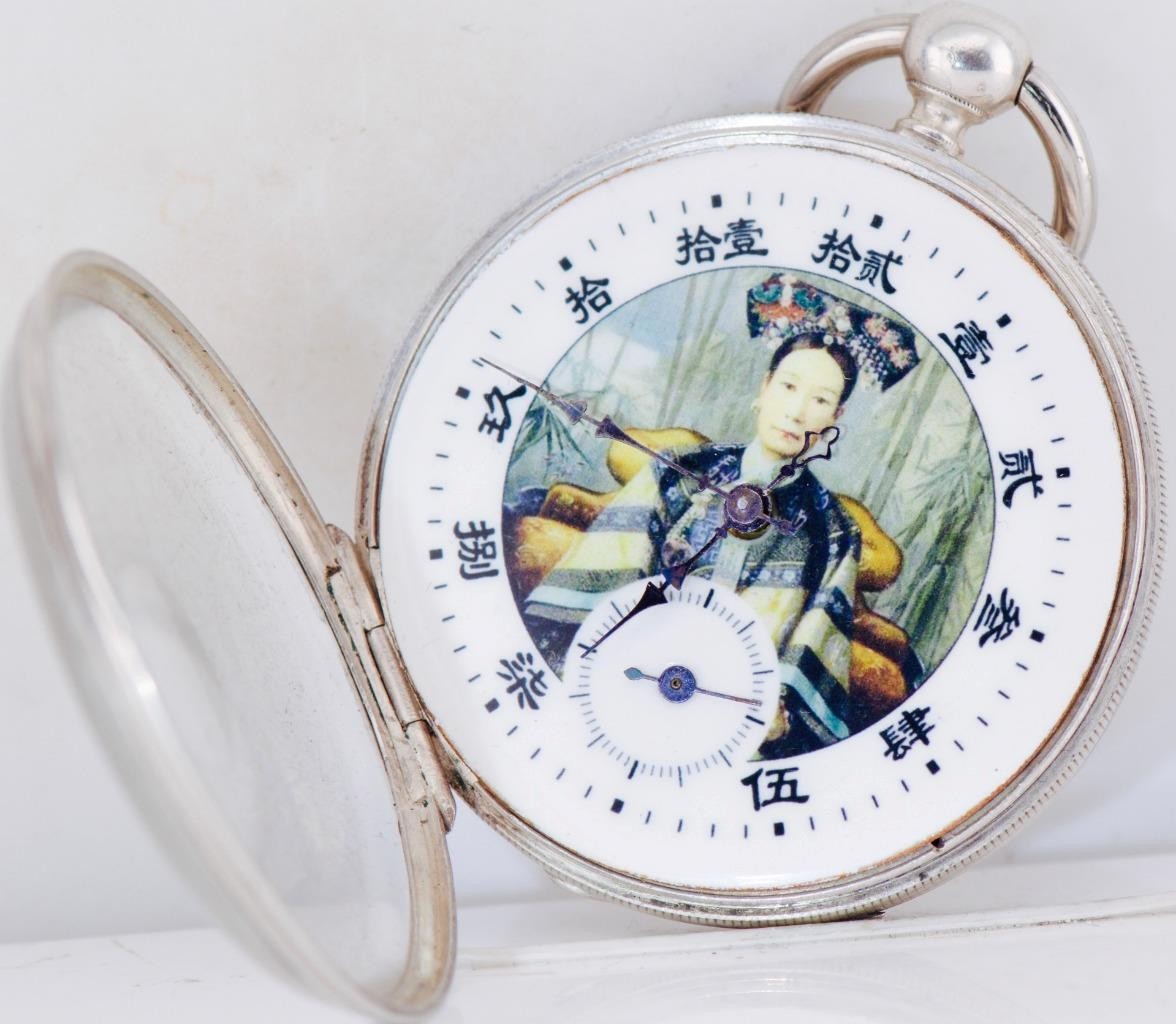
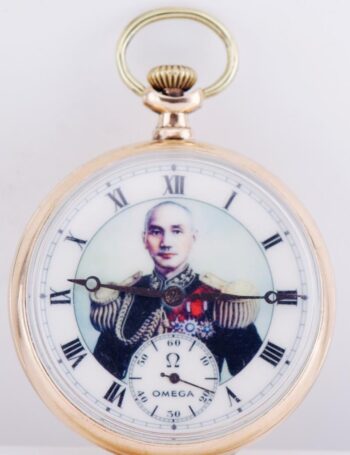
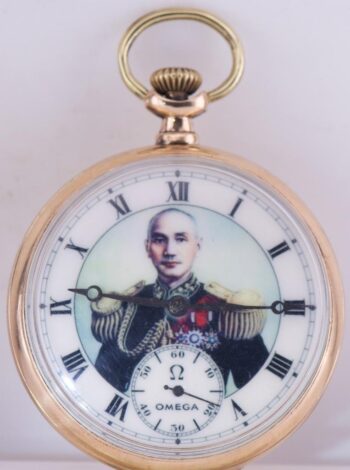
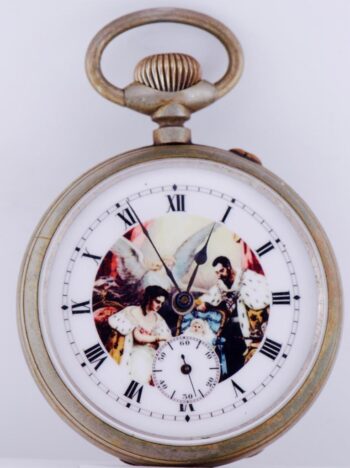
THE DIAL: A ROYAL PORTRAIT The pristine white enamel dial is a visual triumph. It features a striking, finely detailed portrait of Empress Dowager Cixi in traditional imperial headdress and regal robes, set against a subtle bamboo background.
-
Numerals: The hours are marked by traditional Chinese characters, honoring its exclusive market destination.
-
Hands: Elegant, blued steel hands with intricate detailing, alongside a sunken sub-seconds dial at the 6 o’clock position.
-
Condition: Flawless preservation with brilliant colors and no visible hairlines.
THE CASE: SOLID SILVER & HAND-ENGRAVED
-
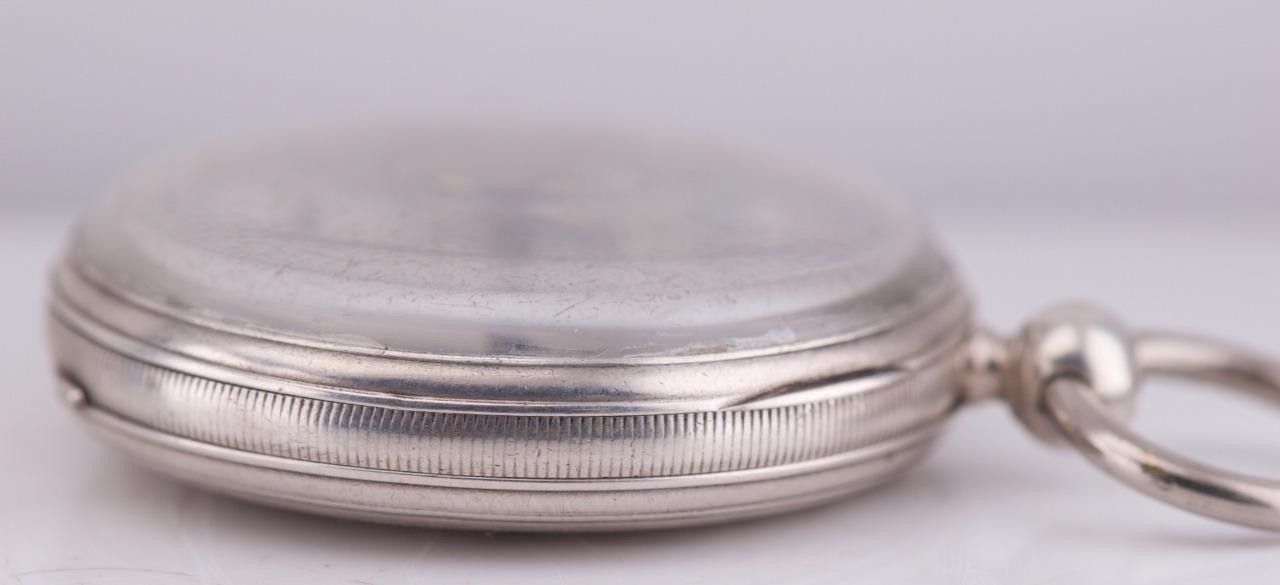
Dimensions: 45mm diameter—a substantial and elegant size.
-
Design: The solid silver case features coin-edge detailing along the sides for superior grip and tactile elegance.
-
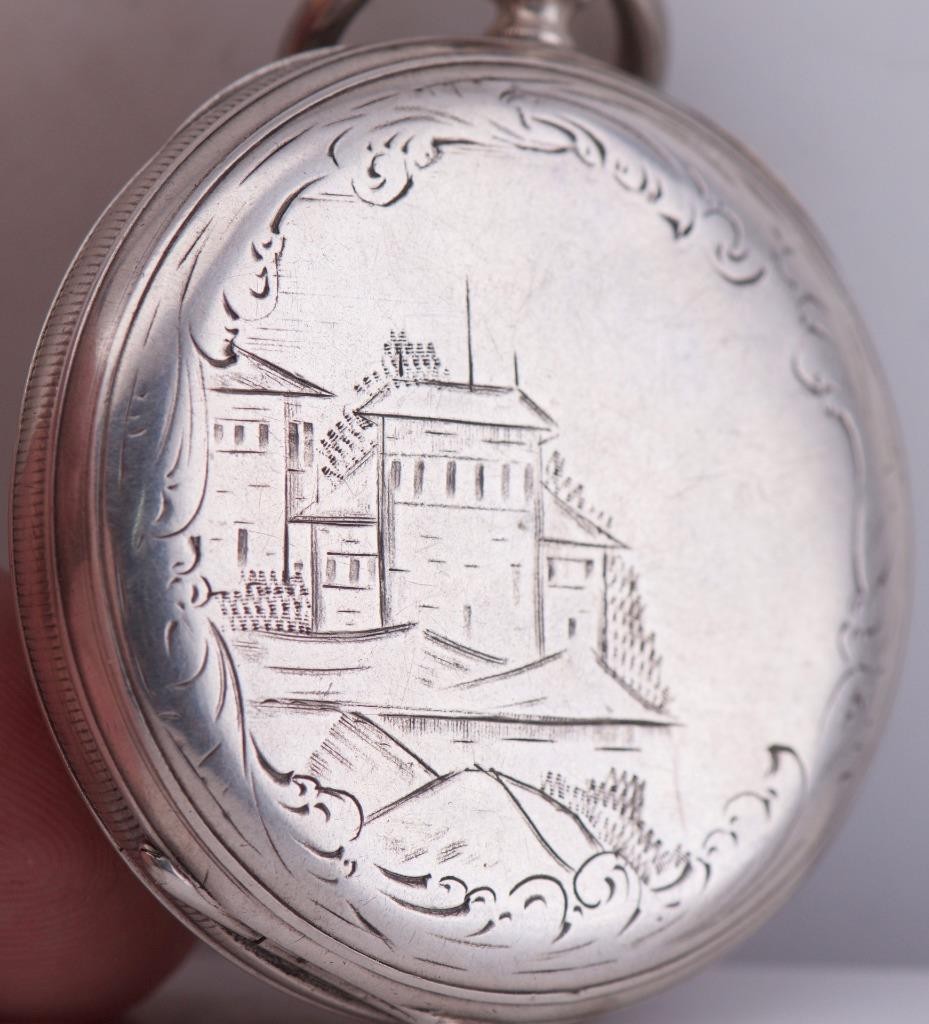
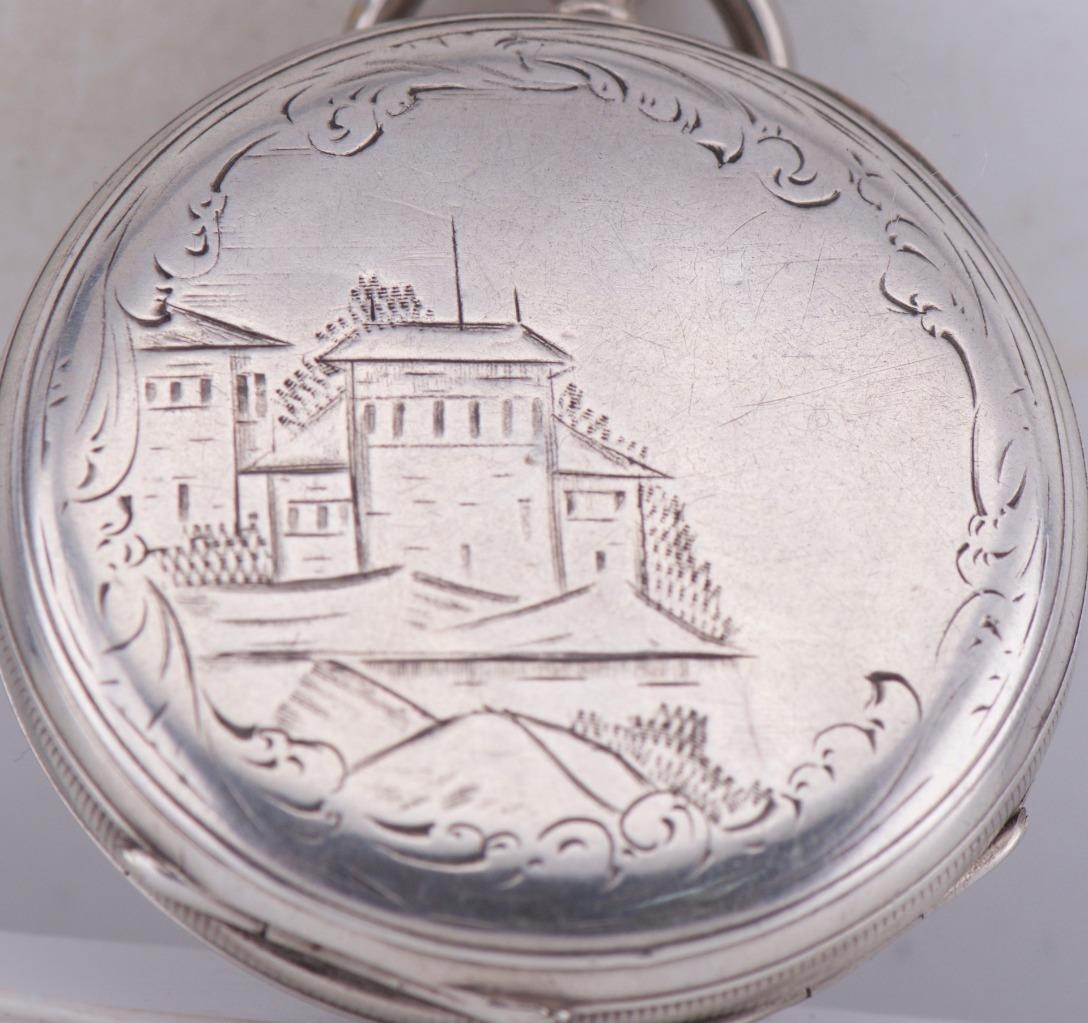
Case Back: The reverse is exquisitely hand-engraved with a serene architectural landscape, depicting a grand riverside villa or fortress nestled among trees—a classic motif of high-end Swiss craftsmanship.
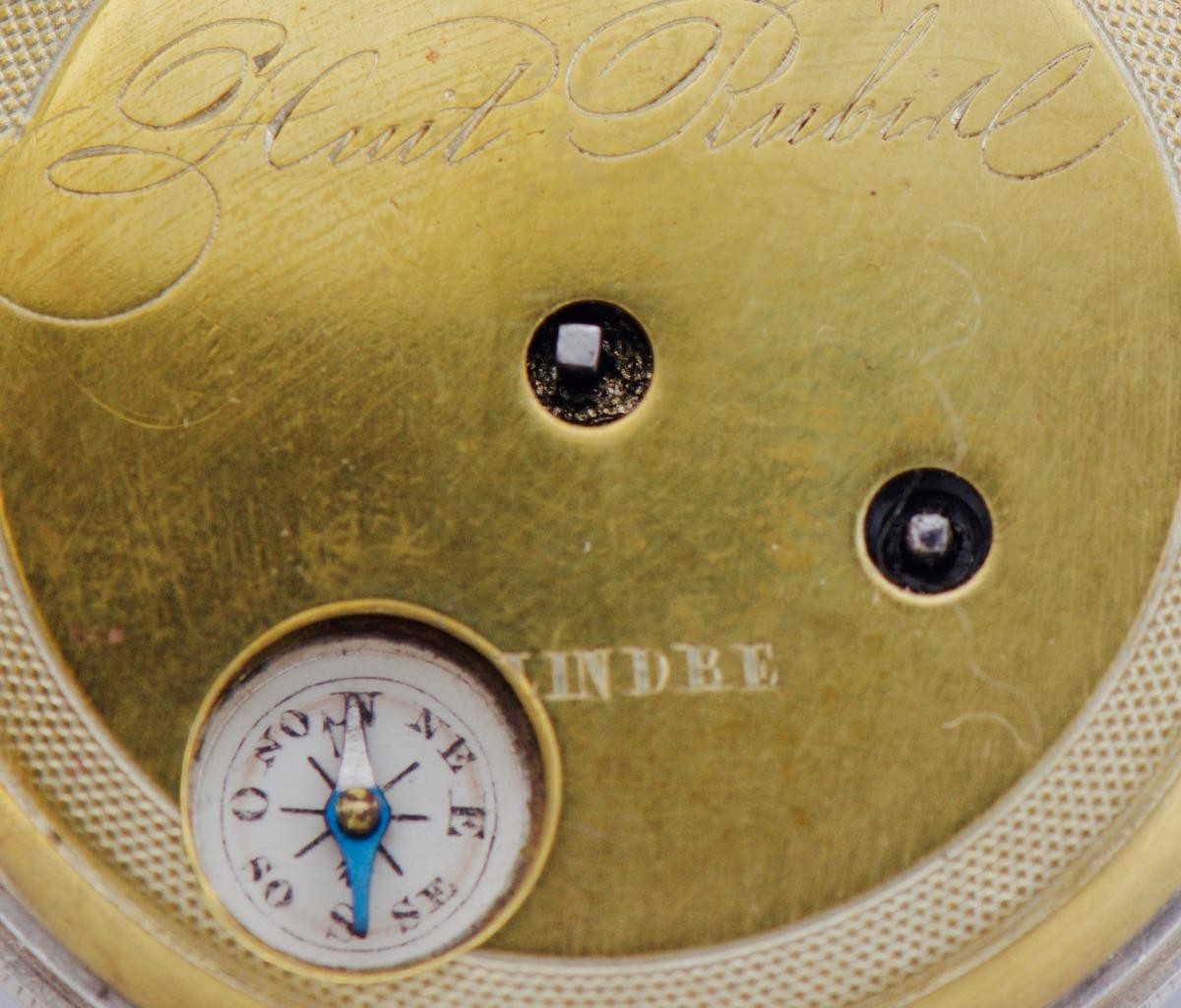
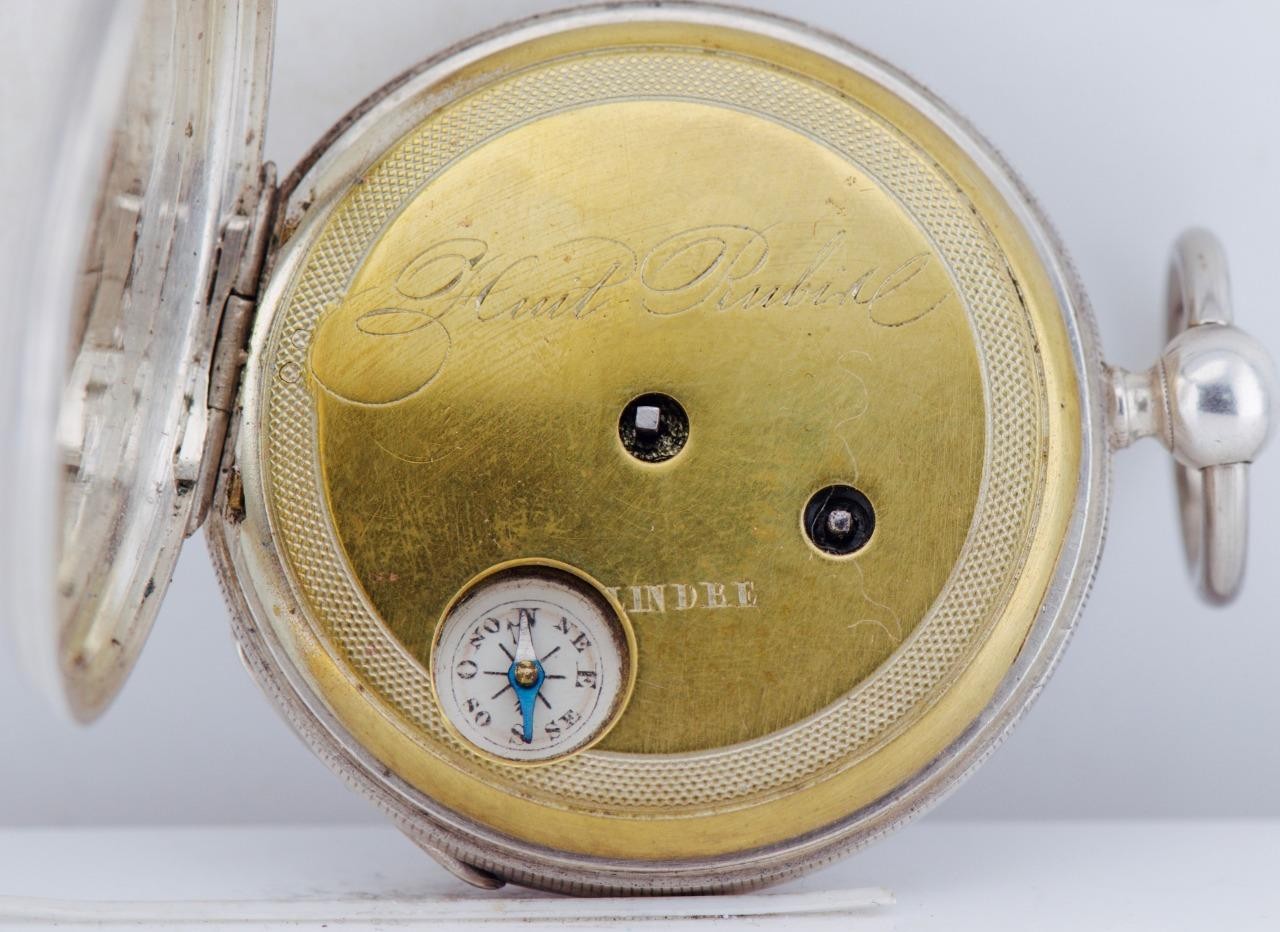
THE MOVEMENT: SKELETONIZED WITH INTEGRATED COMPASS Opening the dust cover (cuvette)—which is elegantly inscribed with “Huit Rubis” (Eight Jewels) and “Cylindre” (Cylinder Escapement)—reveals the true mechanical genius of this piece.
-
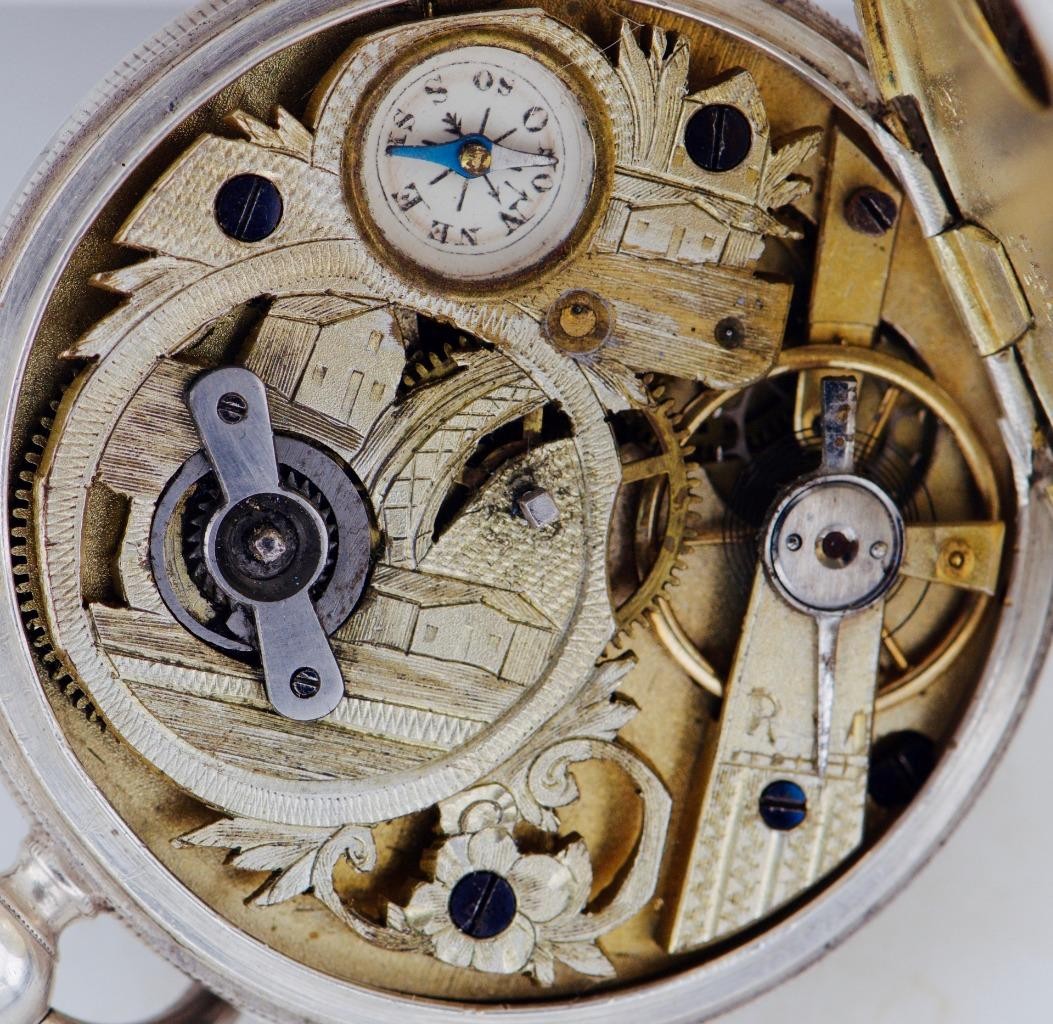
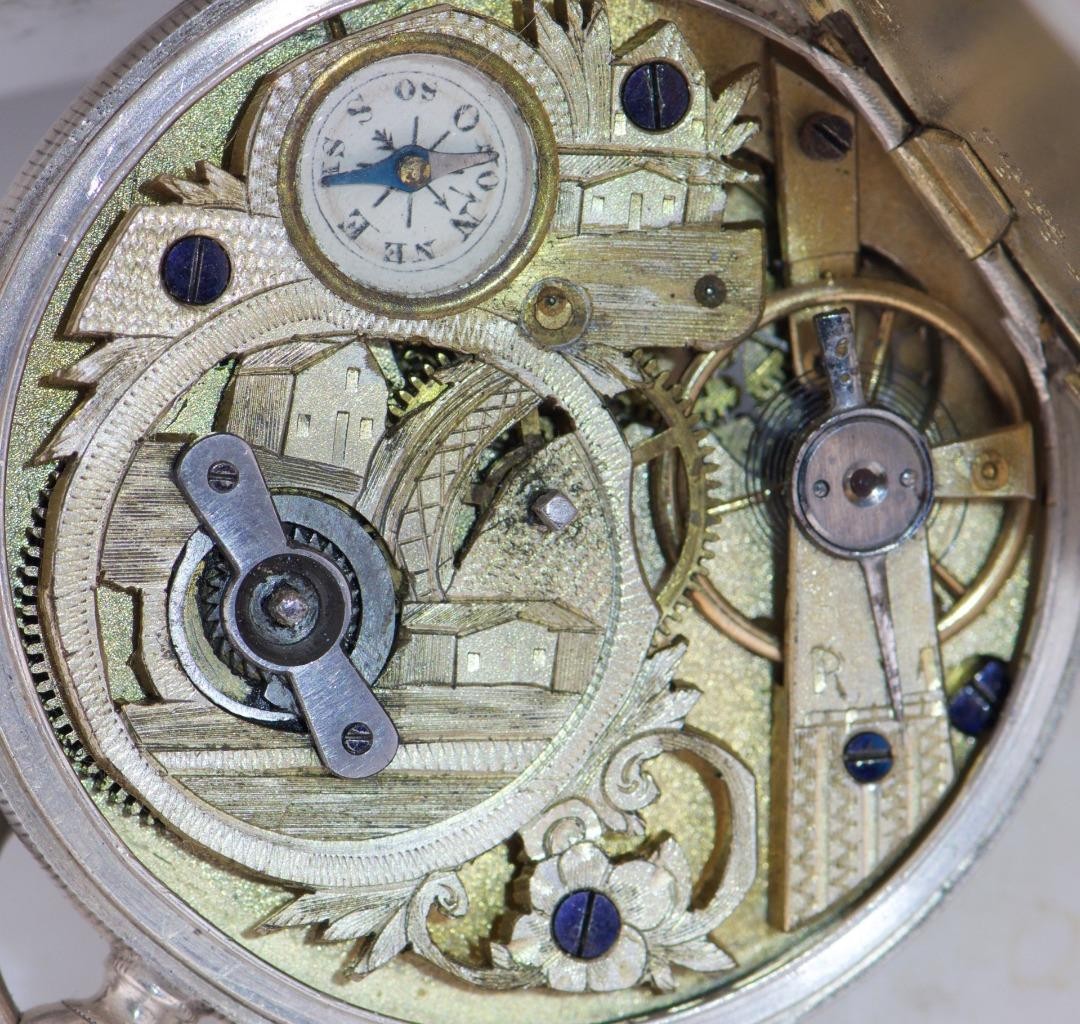
Complication: A beautifully preserved, working miniature compass is integrated directly into the movement block, visible through both the inner cuvette and the movement side—an incredibly rare feature designed to fascinate the original royal owner.
-
Engraving: The lepine-caliber movement is extensively skeletonized and heavily hand-engraved. The bridges feature masterfully executed architectural scenes, floral motifs, and textured finishes that echo the case back’s design.
-
Operation: Key-wound and key-set. The original winding key is included.
CONDITION REPORT Perfect. This museum-grade timepiece has been preserved with the utmost care. The cylinder escapement movement ticks beautifully, the hinges are crisp, and the silver case shows only the gentlest, most desirable antique patina. The compass functions as intended.
SPECIFICATIONS AT A GLANCE:
-
Era: Late 19th / Early 20th Century (Qing Dynasty period)
-
Case Material: Solid Silver
-
Diameter: 45mm (excluding pendant/bow)
-
Dial: Enamel with Imperial Empress Cixi Portrait & Chinese Numerals
-
Movement: Cylinder escapement, 8 Jewels, Skeletonized/Engraved bridges
-
Special Features: Integrated functioning compass, Architectural engraving
-
Accessories: Includes winding/setting key
Do not miss the opportunity to acquire a timepiece that bridges elite European horology and the grandeur of the Chinese Imperial Court. This is a crown jewel for any serious antique watch or Asian arts collection.
Shipping & Handling: Shipped fully insured via FedEx Priority Overnight with signature required.”
The watch comes with an APPRAISAL CERTIFICATE for $5,000.00
Provenance;the watch comes from the most important chinese collection of the bulgarian diplomat Mr.Ferdinandov,who was the Bulgarian ambasador in Beijing during 1960’s. He brought over 1000 Chinese watches and clocks. His collection is considered for the biggest one in the whole Eastern Europe!
Chinese watch history;
Clocks and watches were never devices owned by the everyday citizen of China. The Chinese had been using a public time keeping system that was based on a combination of sun dials, water clocks, and astronomical observations. While the EQUINOCTIAL SYSTEM divides a 24 hour day into 12 equal periods, with each having four quarters (thus each quarter corresponds to an half-hour in western time keeping system), this system was only used by astronomers and astrologers. Because China was an agricultural based society, the PRACTICAL Chinese hours was the TEMPORAL SYSTEM, which were based on sunrise and sunset. Both the day and the night were divided into six equal periods. This obviously made the periods unequal because of seasonal changes: As winter approaches, the “day periods” became shorter; while during the summer, they become longer. To make things even more complicated, in practical use the night was actual divided into five “special” night periods, instead of the theoretical six; and each night period was in turn divided into five “points” equally.
The first Chinese watches were originally constructed by the Mandarin Jesuit missionaries for the Chinese emperors since the late Ming dynasty (late 16th century to 1644). The emperors considered the watches as both astrological toys and jewelry. In fact, horological and astronomical instruments were the items that caught the emperors’ eyes and allowed the missionaries to obtain their feet in the Chinese doo
By the Manuchu (Ch’ing) dynasty (1644 – 1911), watches imported from Switzerland had become the Emperors’ favorite toys. The watches came in different shapes and types (such as a gun form watch, a musical watch, or a singing bird box with a watch), and no expense was spared in terms of jewelry ornamentations. Both the Emperors K’ang-hsi (Kang Xi) (1661-1722) and his grandson, Ch’ien-lung (Chien-Lung) (1735-1796) were well-known watch collectors, the latter had an amazing collection of over a hundred clocks and watches. Today you could still see part of his collection in the National Museum in Beijing. While K’ang-hsi had commissioned watches from his missionaries and Swiss horologers, Ch’ien-lung was more nationalistic by ordering Cantonese artisans to construct clocks in the “western fashion”.
In conclusion, European watches before the 19th century were either specially imported individually (by firms such as Terrot et Fazy), or produced by European expat horologers who followed their missionaries or ambassadors as part of a cultural exchange. The most famous of these horologers were Francois-Louis Stadlin (1658-1740), imperial horologer of K’ang-hsi; and Charles-Henry Petitpierre-Boy (b.1769), who entered the court while following the ambassador of Holland, and built a pendulum clock inside the Old Imperial Summer Palace Yuen-Ming-Yue
By Ch’ien-lung’s son, Chia-Ching’s (1796-1820) reign, several Swiss jewelry and automaton companies, led by Piquet et Meylan and Jacquet-Droz, imported successfully a cylinder watch that was fit inside a gold and enamel empire case with seeded pearls (“Montre D’or Empire”, the French Empire Style Gold Watch). The enamel painting was frequently a depiction of flowers.
The fact that the automaton companies were the leading horological importers of China showed that the Chinese continued to consider watches as mechanical toys. The Chinese were still using the temporal time system in everyday life. Even though some clever watchmakers did create watches that had an adjustable chapter to accommodate the changing time periods, the requirement of having a horologer to adjust the chapter daily rendered the adjustable watch impractical. The normal, “non-adjustable” version, continued to be only used by astrologers. Hence it was no suprise for the automaton companies that their wealthy Mandarin customers were mainly interested in Jewelry watches, or Repeaters. Save for the emperors and his court mathematicians, scientists and astronomers, no one seemed to be interested in purchasing a chronometer, a chronograph, or a calendar watch because no one would use a watch for actual timekeeping. The latter type of watches was particularly impractical in China, because the Chinese had always been using the lunar caleChinese watch history;
If you are not satisfied in any way-money back guarantee.
Free shipping to worldwide.
| Get images thatmake Supersized seem small. | Showcase your items with Auctiva’sListing Templates! |
THE simple solution for eBay sellers.
.aucCounter a { text-decoration:none; }.aucCounter span:hover { text-decoration:underline; }.aucHiddenCounter { display:none; }.aucCounterOrangeText { color:#FB6D05; font-family:Arial; Font-size:13px; Font-weight:bold; }.aucCounterBlueText { color:#0068ac; Font-family:Arial; Font-size:11px; }
Listed with ExportYourStore.com



There are no reviews yet.